



Choosing a lab-grown diamond is no longer just about finding a beautiful stone — it’s about understanding how that stone will look, feel, and age once it becomes part of everyday life.
While most buyers are familiar with the 4 Cs — cut, colour, clarity, and carat — these factors alone don’t fully explain why two diamonds with identical grades can look so different when worn. One of the most influential yet often misunderstood elements is a diamond’s length-to-width ratio.

Diamond ratio governs proportion. It shapes how a diamond presents itself on the hand, how light moves within it, how large it appears relative to its weight, and how harmonious it feels once set. This guide explores lab-grown diamond ratios in depth, moving beyond surface definitions to help you understand why ratios matter and how to choose wisely.
Contents
- The true meaning of a lab-grown diamond ratio
- Why ratio define visual balance more than any single C
- Diamond ratio and the psychology of proportion
- Diamond ratio vs carat weight: understanding visual spread
- Ratio, cut quality, and light behaviour
- Shape-specific ratio guidance with visual intent
- The hidden risks of extreme ratios
- Why lab-grown diamonds allow greater proportional freedom
- How ring design and setting alter ratio perception
- Saratti’s philosophy on proportion, balance, and longevity
- Choosing a ratio that stands the test of time

1. The True Meaning of a Lab-Grown Diamond Ratio
A lab-grown diamond’s length-to-width ratio describes the stone’s face-up outline — the shape you actually see when the diamond is worn.
The ratio is calculated by dividing the diamond’s length by its width, but the number itself is only part of the story. In practice, ratio functions as a visual shorthand that communicates how the diamond’s weight is distributed and how the eye will perceive its form.
For elongated shapes — such as oval, pear, emerald, marquise, radiant, and elongated cushion cuts — ratio determines whether the stone appears:
- Graceful or compact
- Sleek or substantial
- Delicate or bold
It does not indicate quality on its own. Instead, it defines shape character.
2. Why Ratio Defines Visual Balance More Than Any Single C
Cut, colour, clarity, and carat are measurable qualities.
Ratio governs balance — something far more subjective and deeply visual.
A well-chosen ratio can:
- Make a diamond feel intentional rather than accidental
- Create harmony between stone, setting, and hand
- Enhance symmetry and elegance without increasing size
A poorly chosen ratio, however, can cause even a high-quality diamond to feel awkward or visually heavy. This is why experienced jewellers often assess ratio instinctively before considering technical grades.
Ratio acts as the bridge between gemology and aesthetics.
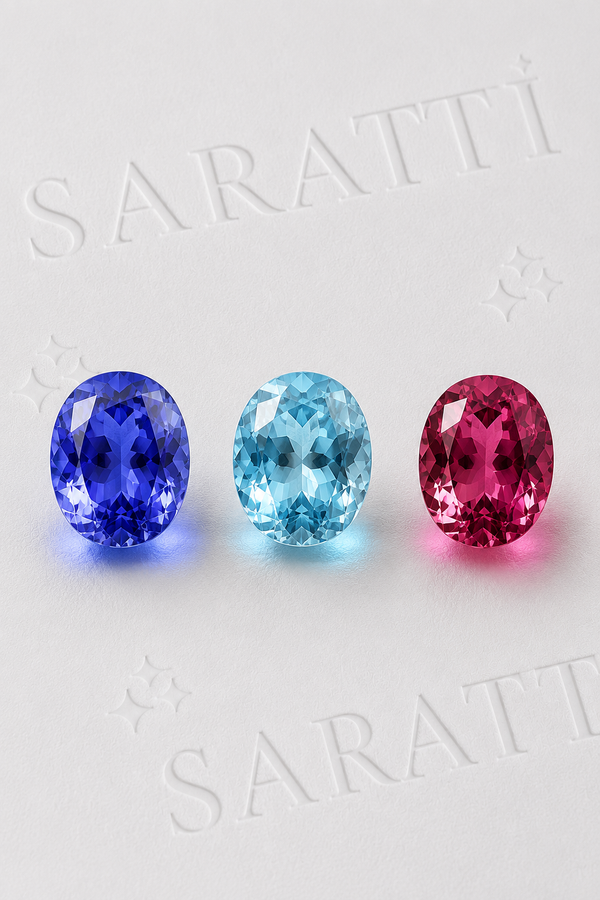
 Two Oval Tri-Stone Rings show completely differently based on ratio. This really affects the overall look.
3. Diamond Ratio and the Psychology of Proportion
Human perception is naturally drawn to balance. We instinctively judge shapes based on proportion, symmetry, and visual flow — even when we don’t consciously realise it.
This is why:
- Elongated ratios often feel slimming on the finger
- Wider ratios feel grounded and substantial
- Certain proportions feel immediately “right”
Diamond ratio plays into these psychological cues. It influences how a ring photographs, how it looks from different angles, and how comfortably it integrates with the wearer’s hand shape.
This is also why ratio preferences are deeply personal. They are tied not just to taste, but to how someone wants their jewellery to feel when worn.
4. Diamond Ratio vs Carat Weight: Understanding Visual Spread
Carat weight measures mass, not surface area. This distinction is essential.
Two lab-grown diamonds of identical carat weight can appear noticeably different in size because:
- One retains weight in depth
- The other spreads weight across length and width
Diamonds with greater face-up spread often appear larger, even without an increase in carat. Elongated ratios naturally encourage this spread, which is why many buyers feel that longer shapes offer better visual presence.
Understanding this relationship allows buyers to prioritise appearance over numbers, avoiding the common misconception that higher carat automatically means larger-looking.
5. Ratio, Cut Quality, and Light Behaviour
While ratio defines shape, it directly interacts with cut quality to determine how light performs.
Balanced ratios support:
- Even light reflection
- Consistent brilliance across the surface
- Symmetry that enhances sparkle
Extreme ratios increase the risk of:
- Bow-tie shadows in elongated cuts
- Light leakage
- Uneven brightness
It’s important to understand that ratio alone cannot guarantee brilliance. A pleasing ratio must be supported by precise cutting and correct facet alignment. The most beautiful diamonds are those where ratio and cut work in harmony, rather than competing with each other.
6. Shape-Specific Ratio Guidance With Visual Intent
Preferred ratio ranges exist because they have proven visually successful across many designs and hand types. These ranges represent low-risk, high-harmony proportions.
|
Shape |
Typical Ratio Range |
Visual Intent |
|
Oval |
1.35 – 1.50 |
Elegant, elongating |
|
Pear |
1.45 – 1.65 |
Graceful, directional |
|
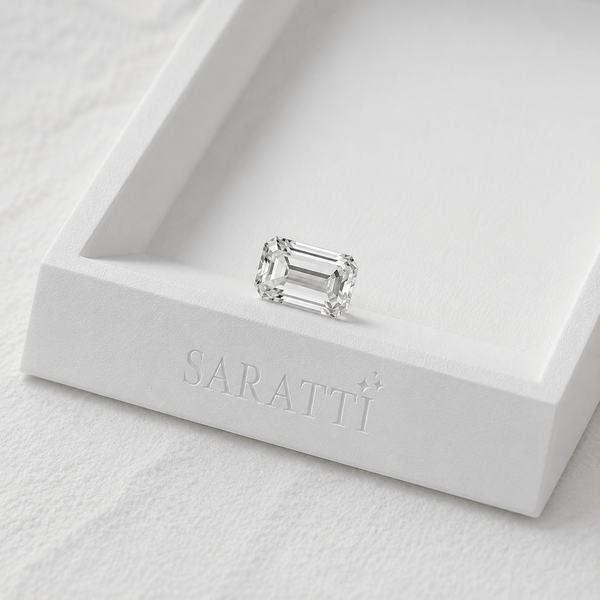
Emerald |
1.30 – 1.50 |
Architectural, refined |
|
Radiant |
1.35 – 1.50 |
Modern brilliance |
|
Cushion (Classic) |
1.00 – 1.05 |
Soft, traditional |
|
Elongated Cushion |
1.20 – 1.45 |
Contemporary balance |
|
Marquise |
1.85 – 2.10 |
Dramatic elongation |
|
Princess |
1.00 – 1.03 |
Bold symmetry |
|
Asscher |
1.00 – 1.03 |
Structured vintage |
|
Heart |
1.00 – 1.05 |
Balanced romance |
|
Elongated Hexagon |
1.60 – 2.00 |
Distinctive modernity |
These ranges are guides, not limitations.
7. The Hidden Risks of Extreme Ratios
Extreme ratios can be visually striking, but they introduce trade-offs.
Highly elongated stones may:
- Emphasise bow-tie effects
- Appear fragile at the tips
- Be more challenging to set securely
Very wide stones may:
- Look heavy or compact
- Conceal weight in depth
- Lose visual elegance in minimalist settings
Understanding these risks ensures that personal style does not come at the expense of wearability or longevity.
8. Why Lab-Grown Diamonds Allow Greater Proportional Freedom
Lab-grown diamonds are produced in controlled environments, removing many of the constraints faced when cutting natural diamonds.
This allows:
- Greater flexibility in shaping
- More consistent proportions
- Less pressure to retain excess weight
As a result, lab-grown diamonds offer a wider range of ratios that prioritise visual harmony rather than yield preservation. This makes it easier to find a diamond that aligns perfectly with a specific design vision.
9. How Ring Design and Setting Alter Ratio Perception
A diamond’s setting can subtly reshape how its ratio is perceived.
- Solitaires emphasise natural outline
- Halo settings add visual width
- Trilogy rings favour balanced proportions
- Bezel settings visually shorten elongated shapes
Considering ratio and setting together ensures that the finished ring feels cohesive, intentional, and refined from every angle.
10. Saratti’s Philosophy on Proportion, Balance, and Longevity
At Saratti, ratio is never evaluated in isolation.
We consider:
- Exact dimensions and facet alignment
- Cut quality and light behaviour
- Setting design and daily wear
- The wearer’s hand, lifestyle, and preferences
Our approach prioritises long-term satisfaction, ensuring every ring feels as beautiful years from now as it does on the first day.
11. Choosing a Ratio That Stands the Test of Time
A lab-grown diamond’s ratio is a personal expression of style. Some gravitate toward sleek elongation, others toward classic symmetry.
Understanding ratios doesn’t restrict creativity — it refines it. With clarity and guidance, choosing a diamond becomes less about second-guessing and more about confidence.
If you would like personalised guidance on lab-grown diamond ratios or custom ring design, our team is always here to help.
Final Thoughts: Why Diamond Ratios Deserve Thoughtful Attention
A lab-grown diamond’s length-to-width ratio is not a technical detail reserved for experts — it is one of the most practical tools a buyer can use to understand how a diamond will actually look and feel when worn.
While carat weight and certification grades provide measurable data, ratio bridges the gap between numbers and real-life appearance. It influences balance, elegance, visual size, comfort, and long-term satisfaction. A thoughtfully chosen ratio ensures that a diamond feels intentional rather than accidental, refined rather than awkward.
Lab-grown diamonds offer greater flexibility in ratio selection than ever before. With that freedom comes the opportunity to choose proportions that reflect personal style, hand shape, and design preference — without unnecessary compromise.
Ultimately, understanding diamond ratios is not about finding perfection.
It is about making an informed, confident choice that continues to feel right long after the ring is worn for the first time.


