
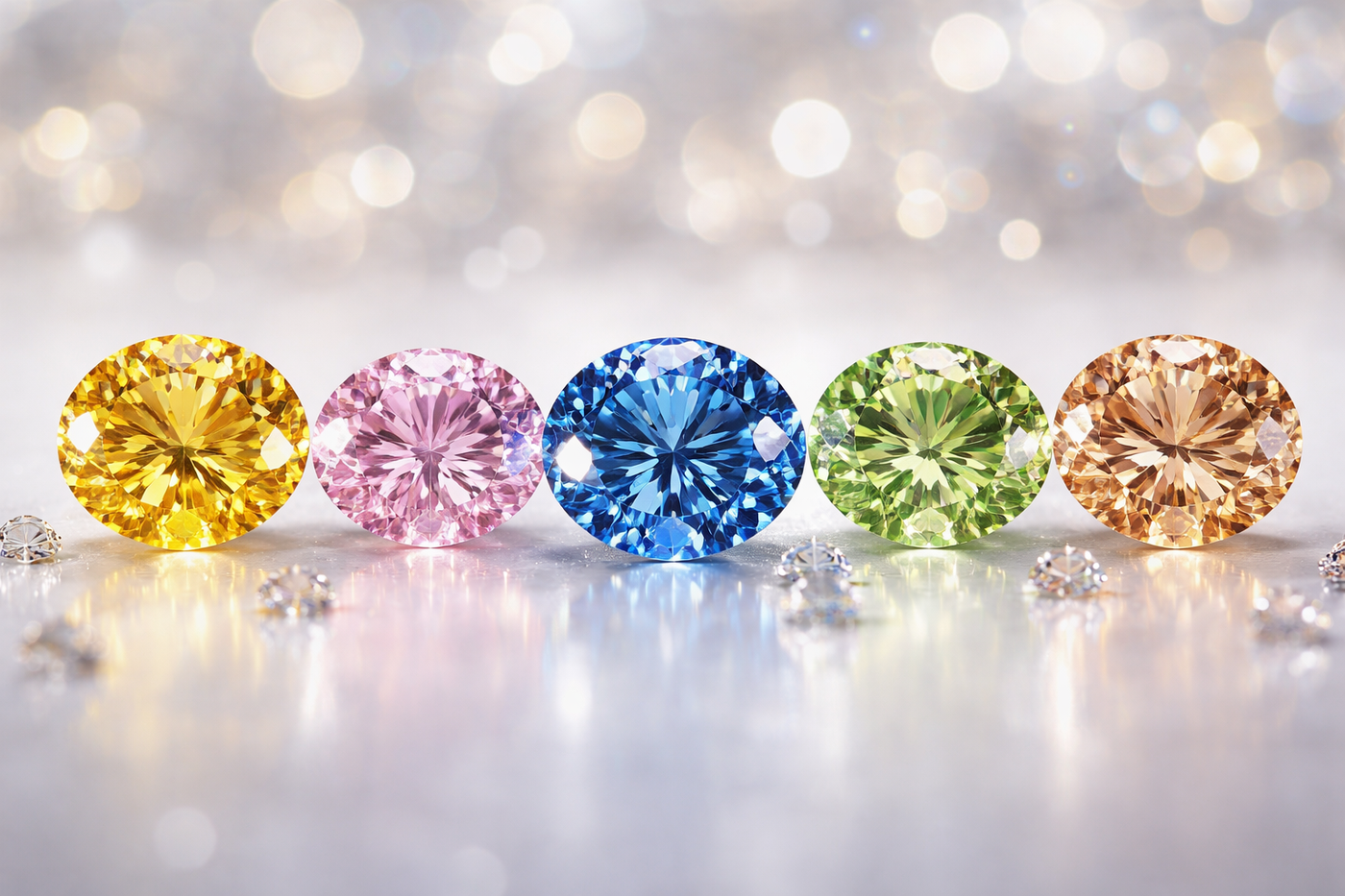
What if a diamond could hold the blue of the ocean, the warmth of sunlight, or the soft blush of a rose? That is the world of fancy colored diamonds. They are not just beautiful. They are exceptionally rare. And unlike traditional white diamonds, they are prized for their color. These are not just gemstones-they are rare expressions of nature’s most extraordinary conditions, formed deep within the Earth over millions of years. From the oceanic depth of a blue diamond to the delicate blush of a pink, fancy colored diamonds exist at the intersection of science, rarity, and emotion.
A fancy colored diamond can appear in yellow, pink, blue, green, orange, purple, red, and more. Some feel bright and joyful. Some feel soft and romantic. Some feel deep, mysterious, and impossible to forget.

What makes them even more fascinating is how rare they are. GIA says only about 1 in 10,000 carats of fashioned diamonds shows enough face-up color to qualify as a fancy color diamond. The Natural Diamond Council also describes fancy color diamonds as only a tiny fraction of all natural diamonds. That makes one thing clear: these are some of the rarest diamonds in the world.
But rarity is only part of the story. That is also why many buyers feel unsure at first. Why are some colored diamonds worth so much more than others? What makes one pink soft and elegant, while another becomes exceptionally rare and valuable? How do you know whether a stone is natural, treated, or lab-grown? And how do you choose one with confidence?
This guide will answer all of that in a clear and simple way. We will start from the beginning. We will explain what fancy colored diamonds are, how they get their color, how the D-to-Z scale connects to the fancy color world, and how grading really works. We will also break down hue, tone, saturation, intensity, cut, clarity, origin of color, and the difference between natural, treated, and lab-grown stones.
If you’ve explored rare gemstones through the Saratti Uncut Blog, you’ll already understand that rarity, origin, and color matter everything. In this guide, we go deeper-bringing together expert insights, market data, and buyer-focused clarity to help you understand and select a truly exceptional stone. By the end, you will not just admire fancy colored diamonds. You will understand them
What Are Fancy Colored Diamonds?
Fancy colored diamonds are real diamonds with visible natural color.That is the simplest way to understand them. Most people know diamonds as white or colorless. But diamonds do not only come in white. Some form in beautiful shades like yellow, pink, blue, green, orange, purple, red, brown, black, gray, and even white. When that color is strong enough to stand out beyond the normal white-diamond range, the stone enters the world of fancy colored diamonds. GIA explains that fancy colored diamonds are valued for visible color beyond the standard D-to-Z range, or for any other face-up color outside that normal scale.

That is what makes them different. In a traditional white diamond, less color is usually better. In a fancy colored diamond, color is the reason the stone matters at all. Its beauty, rarity, and value are all closely tied to that color. GIA notes that while colorless diamonds are graded for the absence of color, fancy colored diamonds are valued for the strength and purity of the color they show. So a fancy colored diamond is not just a white diamond in another shade. It belongs to a completely different category. Fancy colored diamonds are:
- graded differently
- valued differently
- cut differently
- bought differently
The Science Behind Their Color
Each colored diamond tells a unique geological story:
- Nitrogen → Yellow and orange hues
- Boron → Blue diamonds with remarkable depth
- Plastic deformation → Pink and red diamonds
- Natural radiation exposure → Green diamonds
These conditions occur under extremely rare circumstances, which is why colored diamonds are so scarce.

Why Are They Called “Fancy” Diamonds?
The word fancy can sound decorative at first. But in diamonds, it has a technical meaning. It tells us that the diamond has moved beyond the normal white-diamond color scale and now belongs to the colored diamond category. So when you hear names like Fancy Yellow, Fancy Pink, or Fancy Blue, that means the color is strong enough to be treated as an important and desirable feature of the stone. GIA uses this terminology to describe diamonds whose color falls outside the standard colorless-to-light-yellow or brown range.
The D-to-Z Scale Explained
Before you fully understand fancy colored diamonds, you need to understand the color scale used for white diamonds. That scale is called the D-to-Z scale. It is the standard system used to grade the color of most traditional diamonds. GIA explains that this scale measures diamonds from colorless to light yellow or light brown. At first, that may sound simple. But this section matters a lot. Because fancy colored diamonds only make full sense once you see where the white-diamond scale ends.
What Does the D-to-Z Scale Measure?
The D-to-Z scale measures how much color is visible in a diamond that is still part of the traditional white-diamond world. In this system:
- D means colorless
- Z means the diamond shows an obvious light yellow or light brown tint
So the scale is not measuring strong color. It measures how close a diamond is to looking truly white. That is why buyers usually pay more for diamonds closer to D. They look brighter, icier, and more colorless.

A Simple Way to Read the Scale
The easiest way to understand the D-to-Z range is to break it into groups.
D, E, F — Colorless
These diamonds show little to no visible color. They are the iciest part of the scale. They are usually the most prized in the white-diamond category.
G, H, I, J — Near Colorless
These diamonds still look white to many people, especially once they are set in jewelry. But they carry a very slight trace of warmth compared with the D-F range. This part of the scale is often seen as a balance between beauty and value.
K, L, M — Faint Color
Now the warmth becomes easier to notice. These diamonds may show a faint yellow or brown tint, especially when compared side by side with higher-color stones.
N to Z — Noticeable Color
Here, the yellow or brown tint becomes more visible. The diamond still belongs to the traditional white-diamond scale. But the color is now much easier to see.
 GIA explains that once a yellow or brown diamond goes beyond this point, it may move into the fancy color category instead of staying in the D-to-Z system.
Why This Scale Matters So Much
This is the key idea: In white diamonds, color is usually something buyers want less of. That is why the scale starts at D and rewards colorlessness. But fancy colored diamonds work in the opposite way. In their world, color is not a drawback. It is the reason the diamond matters. That is the turning point.
A pale yellow diamond inside the D-to-Z scale is usually judged as a tinted white diamond. A stronger yellow diamond beyond that range becomes a fancy yellow diamond, and now its color can become one of its greatest strengths. GIA says fancy colored diamonds are valued for visible color beyond the normal range, and their value often rises with the strength and purity of the color.
When Does a Diamond Stop Being “White” and Start Being “Fancy Colored”?
This is one of the most important beginner questions. A diamond stops being judged as part of the white-diamond scale when the color becomes strong enough to move beyond the normal D-to-Z range. For yellow and brown diamonds, that means the color becomes deeper than Z. For other colors, like pink, blue, green, orange, or red, the diamond already belongs to the fancy color world because those colors sit outside the normal white-diamond scale altogether. That is why fancy colored diamonds are not just “slightly more colorful” white diamonds. They are a separate category with a different grading logic.
 Why Beginners Often Get Confused
This is where many readers get lost. They hear that diamonds are graded by color. Then they hear that colored diamonds are also graded by color. So they assume the same rules apply. They do not.
In white diamonds, Less color is usually better. In fancy colored diamonds, The right color is usually more valuable. That is the easiest way to remember the difference.
The Most Important Thing to Remember
The D-to-Z scale is the last stop before the world of fancy colored diamonds begins. It helps you understand:
- Why white diamonds are valued for colorlessness
- Why faint yellow is not the same as fancy yellow
- Why colored diamonds need a completely different grading system
Once you understand that, the rest of the fancy-color world becomes much easier to follow.
How Fancy Colored Diamonds Get Their Color
The color in a fancy colored diamond is not added from the outside. It is part of the diamond itself. That is one of the most important things to understand. A fancy colored diamond gets its color because of what happened inside the stone while it was forming deep within the Earth. Tiny changes in the crystal can affect the way the diamond absorbs and reflects light. That is what creates the color you see. GIA explains that fancy diamond color can come from trace elements, structural features, or other natural conditions inside the crystal. So when you look at a fancy colored diamond, you are not just looking at a beautiful surface. You are looking at the result of a rare geological story.
The Basic Idea, Made Simple
A diamond looks the way it does because of how it handles light. If something inside the crystal changes the way light passes through it, the diamond can appear colored instead of white. That change may come from:
- Tiny trace elements
- Pressure-related changes in the crystal structure
- Natural radiation over long periods of time
Those hidden differences create some of the rarest diamond colors in the world.
Trace Elements and Crystal Changes
Some fancy colored diamonds get their color from very small amounts of other elements inside the crystal. Others get their color because the crystal structure itself changed while the diamond was forming. This is why two diamonds can both be natural, but still look completely different. The diamond is still a diamond. But something unusual happened inside it.
- One may glow with yellow warmth.
- Another may show a cool blue tone.
- Another may carry a soft pink blush.

Common Causes Behind Different Colors
Here are some of the best-known examples.
Yellow Diamonds
Yellow diamonds are usually linked to nitrogen. Nitrogen inside the crystal changes how the diamond absorbs light, which can make it appear yellow. This is one reason yellow diamonds are among the more familiar fancy colors.
 Blue Diamonds
Blue diamonds are usually linked to boron. Boron is a rare element in diamonds, and that is part of why natural blue diamonds are so unusual and valuable.
 Pink and Red Diamonds
Pink and red diamonds are especially fascinating because their color is not usually explained by the same kind of trace-element story seen in yellow or blue diamonds. Instead, their color is generally linked to structural distortion in the crystal lattice. In simple words, pressure changed the internal structure of the stone in a way that changed how light behaves inside it. That is one reason pink and red diamonds feel so mysterious.
 Green Diamonds
Green diamonds are often linked to natural radiation exposure. This does not mean something modern or dangerous happened to them. It means the diamond was naturally exposed to radiation in the earth over a very long time, which affected the surface or outer areas of the crystal and changed its color.
 Brown Diamonds
Brown diamonds are often linked to structural distortion in the crystal, much like pink diamonds, though the final appearance is very different.
 Orange and Other Rare Colors
Orange, purple, and some unusual mixed colors can come from more complex or very rare structural and chemical conditions. That is one reason truly fine stones in these colors are so difficult to find.

Why Some Colors Are So Much Rarer Than Others
Not every color forms with the same frequency. Yellow diamonds are more available because the conditions that create yellow are more common than the conditions needed for colors like red, blue, or green. That is why color rarity is not equal across the category. Some colors appear more often. Some appear only under exceptional conditions. And some appear so rarely that even small fine stones become major treasures. GIA notes that red, green, purple, and orange are generally the rarest fancy color families overall, while yellow and brown are the most common.
 Rarity Ranking (Critical for Buyers)
Understanding rarity is essential:
- Red diamonds – extremely rare (only a few dozen known)
- Pink diamonds
- Blue diamonds
- Green diamonds
- Orange and violet diamonds
- Yellow diamonds (most available)
👉 This hierarchy directly impacts pricing and desirability.
Types of Fancy Colored Diamonds (By Color)
Fancy colored diamonds come in a wide range of colors, each with different rarity and value.
|
Color |
Rarity |
Price Level |
Popular Use |
|
Yellow |
Common |
Moderate |
Jewelry |
|
Pink |
Rare |
Very High |
Investment |
|
Blue |
Extremely Rare |
Ultra High |
Luxury pieces |
|
Green |
Rare |
High |
Collectors |
|
Red/Purple |
Exceptionally Rare |
Extreme |
Investment |
Key insight: rarity increases exponentially with certain colors, especially pink, blue, and red.
The Main Fancy Colored Diamond Colors
Fancy colored diamonds come in a wide range of colors. But not all colors are equally common. And not all colors are valued the same way. Understanding these color families will help you see how the category really works.
- Some are relatively available.
- Some are extremely rare.
- Some sit at the very top of the luxury market.
Yellow Diamonds
Yellow diamonds are one of the most well-known fancy colored diamonds. They are often the first color people discover. Their color usually comes from nitrogen inside the diamond, which affects how light is absorbed. Yellow diamonds can range from:
- Soft, light yellow
- To rich, deep, vivid yellow
The most valuable yellow diamonds usually fall into:
- Fancy Intense
- Fancy Vivid
These stones feel bright, warm, and full of life. They are also more available than most other fancy colors, which makes them a popular entry point for buyers. Best known for: warmth, brightness, accessibility
Pink Diamonds
Pink diamonds are among the most desired diamonds in the world. Their color is not caused by trace elements in the usual way. Instead, it is linked to structural distortion inside the crystal. That makes them both rare and fascinating. Pink diamonds can appear as:
- Soft blush tones
- Strong, vivid pink
- Purplish pink variations
The most valuable stones are:
- Fancy Intense Pink
- Fancy Vivid Pink
These diamonds feel romantic, elegant, and highly collectible. Their rarity has increased even more after the closure of major sources like the Argyle mine. Best known for: romance, rarity, collector demand
 Blue Diamonds
Blue diamonds are some of the most prestigious diamonds in the world. Their color is usually linked to boron, a rare element in diamonds. That alone makes them unusual. Blue diamonds often appear as:
- Light blue
- Grayish blue
- Deep, vivid blue
The most valuable are:
- Fancy Intense Blue
- Fancy Vivid Blue
These diamonds feel:
- Cool
- Powerful
- Elegant
They are strongly associated with luxury and high-value auctions. Best known for: prestige, rarity, deep color presence
Green Diamonds
Green diamonds are especially intriguing. Their color is usually caused by natural radiation exposure over long periods of time. Unlike other colors, green often appears: on the surface or unevenly across the stone. That makes natural green diamonds particularly rare.
They can appear as:
- Light green
- Olive tones
- Grayish green
Fine stones with strong, even green color are extremely rare. Best known for: uniqueness, mystery, rarity
Brown and Champagne Diamonds
Brown diamonds are more common than many other fancy colors. But that does not make them unimportant. These names reflect their warm, rich tones. They are often marketed as:
- Champagne diamonds
- Cognac diamonds
They can appear as:
- Light brown
- Golden brown
- Deep chocolate tones
They often feel:
- Earthy
- Elegant
- Understated
Because they are more available, they can also offer better value for buyers. Best known for: warmth, affordability, subtle elegance
 Orange Diamonds
Orange diamonds are rare and striking. Their color can come from complex nitrogen-related structures. Pure orange diamonds (without modifiers) are especially rare.
They often appear as:
- Vivid orange
- Orangy yellow
- Brownish orange
These diamonds feel:
- Energetic
- Bold
- Unique
A strong fancy vivid orange diamond can be extremely valuable. Best known for: vibrancy, rarity, bold appearance
 Purple and Violet Diamonds
Purple and violet diamonds are less commonly seen, but highly fascinating. Their color is often linked to:
- Hydrogen
- Or Complex structural effects
They can appear as:
- Soft lavender
- Deep violet
- Grayish purple
These stones often feel:
- Artistic
- Unusual
- Refined
Fine examples are rare and can be highly collectible. Best known for: uniqueness, artistic appeal
 Red Diamonds
Red diamonds sit at the very top of rarity. They are often described as the rarest fancy colored diamonds in the world. Their color is believed to come from extrme structural distortion. Unlike other colors, red diamonds are usually found in:
- Very small sizes
- Very limited quantities
They often appear as:
- Deep red
- Slightly purplish red
These stones feel:
- Intense
- Powerful
- Almost mythical
Even a small red diamond can be incredibly valuable. Best known for: rarity, highest prestige
 Black Diamonds
Black diamonds have a very different appearance from other fancy colored diamonds. They are often:
- Opaque
- Heavily included
Their color comes from:
- Dense inclusions
- Graphite or other internal features
They do not sparkle like traditional diamonds. Instead, they offer:
- Bold
- Dramatic
- Modern appeal
They are popular in contemporary jewelry. Best known for: boldness, modern style
 Gray and White Fancy Diamonds
Gray and fancy white diamonds are less discussed but still important. Gray diamonds can appear as:
- Soft gray
- Bluish gray
- Metallic tones
They often feel:
- Subtle
- Modern
- Understated
They appear:
- Milky
- Cloudy
- Soft in appearance
Fancy white diamonds are different from colorless diamonds. These are niche but interesting parts of the category.
 Why Understanding Color Families Matters
Each color family:
- Has its own rarity level
- Has its own market demand
- Behaves differently in pricing
- Creates a different emotional response
That is why you should not just ask: “Is this a fancy colored diamond?” You should also ask: “What kind of fancy colored diamond is it?”
 The Key Takeaway
Not all fancy colored diamonds are the same.
- Some are bright and accessible
- Some are rare and collectible
- Some are extremely rare and seldom seen
Understanding the color families helps you:
- Compare stones properly
- Understand value differences
- Choose more confidently
How Fancy Colored Diamonds Are Graded: Hue, Tone, and Saturation
Now that you understand where color comes from, the next step is learning how that color is judged. This is where many beginners feel confused. Fancy colored diamonds are not graded the same way as white diamonds. Instead of focusing on how little color a diamond has, this system looks at how the color actually appears. Three main ideas are used:
- Hue
- Tone
- Saturation
 Once you understand them, you can read a fancy colored diamond much more clearly. These three together describe what the color really looks like.

Hue: What Color Do You See?
Hue is the simplest part. It means the main color of the diamond. Examples:
- Yellow
- Pink
- Blue
- Green
- Orange
- Purple
Hue answers one basic question: What color is this diamond? But in many diamonds, it is not just one color. There can also be a second color influence. That is where primary hue and secondary hue come in.
Primary Hue vs Secondary Hue
This is one of the most overlooked parts of the topic. And it matters more than many buyers realize. Many fancy colored diamonds do not show just one color. They show a primary hue plus a secondary hue, also called a modifier. Your uploaded draft highlights this too, noting that pure single hues are typically more valuable, while modifiers can either enhance uniqueness or reduce value depending on the combination.
👉 Pure, single hues are typically more valuable, while secondary modifiers can either enhance uniqueness or reduce value depending on the combination.
What primary hue mean
The primary hue is the main color you see first. If a diamond is described as yellow, pink, or blue, that one hue is the main identity of the stone.
What secondary hue mean
A secondary hue is an extra color influence that modifies the main one. Examples:
- Orangy yellow
- Greenish yellow
- Brownish pink
- Purplish pink

How the naming works
The Diamond Pro explains the naming rule clearly. In a name like orangy yellow, yellow is the primary hue, and orange is the modifier. If two colors are more balanced, the name can appear more like a shared identity, such as orange-yellow.
Why secondary hue matters
A secondary hue can affect:
- How pure the color looks
- How warm or cool it feels
- How rare the stone feels
- How the market values it
- Whether the stone looks bright, soft, muddy, smoky, or unusual
A modifier is not always bad. Sometimes it adds beauty. Sometimes it adds individuality. Sometimes it lowers purity. That is why you should never stop at the first color word. Read the full color description.
Tone: How Light or Dark Is the Color?
Tone describes the depth of the color. In simple terms, it answers: Is the color light or dark? A diamond can have:
- Light tone
- Medium tone
- Deep tone
- Dark tone

Tone changes the feeling of the diamond. Two diamonds can have the same hue but feel completely different because of tone.
- Light tone can feel soft and airy
- Medium tone often feels balanced and easy to wear
- Deep tone can feel rich and intense
- Dark tone can feel dramatic and bold

Saturation: How Strong and Pure Is the Color?
Saturation is one of the most important factors. It describes how strong, clean, and vivid the color looks. This answers the question: Does the color feel weak or powerful? A diamond with:
- Low saturation may look soft, grayish, or diluted
- High saturation looks rich, clear, and full of life

This is often the part that creates the emotional reaction. When people say: “This color is stunning”, they are usually reacting to strong saturation.
How Hue, Tone, and Saturation Work Together
These three are not separate. They work together to create the final look. For example:
- Diamond may have a beautiful hue, but if the saturation is weak, it may feel dull
- Diamond may have strong saturation, but if the tone is too dark, it may feel heavy
- Balanced combination often creates the most attractive result
That is why grading fancy colored diamonds is more complex than it first appears.

Why This System Matters So Much
This grading system helps explain why:
- Two diamonds with the same color name can look very different
- One diamond feels more “alive” than another
- Some stones are much more valuable than others
It also helps you move beyond simple labels like “pink” or “blue”. Because in reality, no two pink diamonds are exactly the same.
The Most Important Thing to Remember
Hue tells you what color it is. Tone tells you how light or dark it feels. Saturation tells you how strong and pure it looks. Together, they define the identity of the diamond.
The Full Fancy Color Intensity Scale Explained
Now that you understand hue, tone, and saturation, the next step is seeing how all of that is combined into a grading system. This is called the fancy color intensity scale. It describes how strong and visible the color appears in the diamond. And this is where value differences become very clear. Because two diamonds with the same color can have very different prices depending on their intensity grade.
The Full Fancy Color Scale (From Lightest to Strongest)
The standard progression used by GIA moves from very subtle color to very strong color. Here is the full scale: Each step reflects a change in how the color looks to the eye.
- Faint
- Very Light
- Light
- Fancy Light
- Fancy
- Fancy Intense
- Fancy Vivid
- Fancy Dark
- Fancy Deep

Understanding Each Grade (Simple and Clear)
Let’s go through them one by one.
Faint
This is the softest level of color. The color is barely noticeable. It may feel more like a hint than a true color presence. This level usually does not create a strong emotional impact.
Very Light
The color becomes slightly easier to see.
- Still soft.
- Still gentle.
- Still not very strong.
Light
Now the color is clearly visible. But it still feels delicate rather than bold. This can be attractive for buyers who prefer a subtle look.
Fancy Light
This is where the diamond starts to feel clearly “colored.” The color is noticeable and pleasant. It begins to show real personality.
Fancy
This is a balanced level. Many diamonds in this range look elegant and refined. The color is:
- Clear
- Visible
- Well-defined
Fancy Intense
Now the color becomes stronger and more exciting. This is one of the most popular levels for many buyers. It offers strong color without becoming too heavy. It feels:
- Richer
- More vibrant
- More expressive
Fancy Vivid
This is one of the most desirable levels in many color families. This is often where the diamond feels most powerful visually. Many of the world’s most famous colored diamonds fall into this category. The color is:
- Strong
- Bright
- Pure
- Lively
Fancy Dark
Now the color becomes deeper. This is not necessarily better or worse. It simply creates a different look. It may feel:
- Moodier
- More dramatic
- Slightly heavier
Fancy Deep
This combines strong color with a deeper tone. Some stones in this category look luxurious and bold. Others may feel too dark depending on the hue. The color feels:
- Rich
- Saturated
- Full

Why Intensity Matters So Much
This is the key idea: Color intensity is one of the biggest drivers of value.
A smaller diamond with strong color can be worth more than a larger diamond with weak color. For example:
- Fancy Vivid pink can be far more valuable than a larger Light pink
- Fancy Intense yellow can feel much more alive than a pale yellow
That is why buyers should never look at size alone. Color strength changes everything.

Important: It Is Not a Simple “Higher Is Always Better” Scale
Many beginners assume: Higher grade = better diamond. But that is not always true. The best grade depends on:
- The color itself
- How the diamond looks face-up
- Personal preference
For example:
- Some people love the softness of Fancy Light
- Others prefer the strength of Fancy Intense
- Some colors look better in Vivid
- Some look more elegant in slightly softer tones
So the goal is not just to go higher. The goal is to find the most beautiful balance.

How Intensity Connects to Hue, Tone, and Saturation
Intensity is not a separate idea. It is built from:
- Hue (what color it is)
- Tone (how light or dark it is)
- Saturation (how strong it is)
That means two diamonds can both be “Fancy Intense” but still look different. Because their tone or hue may not be the same.

The Most Important Thing to Remember
- Intensity describes how strong the color appears
- It is one of the biggest value drivers
- It works together with hue and tone
- It should always be judged visually, not just by the label
Shape and Cut: How They Influence Color and Beauty
In white diamonds, the cut is usually about sparkle. In fancy colored diamonds, cut has a different role. It is not just about brilliance. It is about bringing the color to life. This is one of the most important ideas in the entire guide. Because a well-cut, fancy colored diamond can look richer, deeper, and more beautiful. A poorly cut one can make the color feel weak or uneven.
Why Cut Matters More in Fancy Colored Diamonds
A diamond’s cut controls how light moves inside the stone. In white diamonds, the goal is usually:
- Maximum brilliance
- Strong sparkle
- Light return
But in fancy colored diamonds, the cutter often has a different goal:
- Make the color look stronger
- Make the color look more even
- Protect the most attractive face-up appearance
GIA explains that colored diamonds are often cut to maximize color intensity, not just brilliance. That changes everything.
How Cut Affects Color
A fancy colored diamond is not just shaped for beauty. It is shaped to control how the color appears. Here is how cut influences color:
- Deeper cuts can make color appear stronger
- Shallower cuts may make the color look lighter
- Certain shapes hold color better than others
- Facet arrangement can concentrate or spread color
That means two diamonds with the same color grade can still look very different depending on the cut.

The Most Popular Shapes for Fancy Colored Diamonds
Some shapes are especially loved in fancy colored diamonds because they help hold and enhance color.
Radiant Cut
One of the most popular choices. Radiant cuts are often chosen when color intensity is the priority..Why it works:
- Strong color concentration
- Lively appearance
- Excellent for yellow and many other colors
Cushion Cut
A classic and very elegant shape. Many famous fancy colored diamonds are cut in cushion shapes. Why it works:
- Soft, rounded corners
- Romantic look
- Holds color beautifully
Oval Cut
Elegant and slightly elongated. Oval cuts can create a graceful and modern look. Why it works:
- Larger face-up appearance
- Smooth flow of color
- Flattering on the hand
Pear Cut
Distinctive and expressive. Pear shapes often feel bold and artistic. Why it works:
- Unique shape
- Strong personality
- Good color presence in many stones
Emerald Cut
Clean and structured. However, because it is more open, it may not concentrate color as strongly as mixed cuts. Why it works:
- Step-cut facets create a refined look
- Highlights clarity and tone
- Gives a calm, elegant appearance
Round Brilliant Cut
The most common shape in white diamonds. But less common in top fancy colors. Still beautiful, but not always the first choice for colored diamonds. Why it works:
- It is optimized for sparkle
- Not always ideal for holding strong color

How Cutters Make Decisions
Cutting a fancy colored diamond is a careful balance. The cutter must decide:
- How to preserve weight
- How to enhance color
- How to keep the stone lively
- How to avoid dull areas
Sometimes this means sacrificing perfect symmetry or maximum brilliance to protect the color. That is why fancy colored diamonds are often cut differently from white diamonds.
👉 In colored diamonds, cut is a tool to amplify color presence, not just brilliance.
What Buyers Should Look For
When choosing a fancy colored diamond, do not ask only: “Does it sparkle?”
Instead, ask: (These questions will guide you better)
- Does the color look rich and attractive?
- Does the diamond look lively face-up?
- Is the color evenly distributed?
- Does the shape suit the personality of the color?
Common Mistakes Buyers Make
Many buyers focus too much on:
- Carat weight
- Or Sparkle
And forget to evaluate how the cut affects color. But in fancy colored diamonds, color is the main story. And cut is what helps tell that story clearly.
The Most Important Thing to Remember
Cut is not just about beauty. It is about how the color appears. So never separate cut from color. They always work together.
A great cut can:
- Strengthen color
- Improve balance
- Make the diamond feel more alive
A weak cut can:
- Dilute the color
- Create uneven patches
- Reduce visual impact
Clarity in Fancy Colored Diamonds: What Really Matters
Clarity is one of the traditional “4Cs” of diamonds. But in fancy colored diamonds, it works a little differently. If you are used to white diamonds, this is where your thinking needs to shift. Because in this category, clarity is important. But it is usually not the first priority.
What Clarity Actually Means
Clarity describes how clean the diamond is. It looks at two things:
- Inclusions → tiny features inside the diamond
- Blemishes → small marks on the surface
Almost every diamond has some inclusions. The question is not whether they exist. The question is: Do they affect how the diamond looks and performs?
 How Clarity Works in White Diamonds vs Fancy Colored Diamonds
This is where the difference becomes clear. In white diamonds, Clarity is often a major focus. Because buyers are chasing:
- Brightness
- Transparency
- Clean, icy look
Even small inclusions can reduce that effect. In fancy colored diamonds, The priority shifts. Color becomes the main focus. That means a diamond with:
- Incredible color
- Strong saturation
- Beautiful face-up appearance
can still be highly desirable even if the clarity is not perfect. GIA also explains that fancy colored diamonds can still be prized even with lower clarity if the color is exceptional. That is the key idea.
Why Clarity Still Matters
Clarity may not lead. But it still matters. Here’s why:
1. Visual impact
If inclusions are: large, dark or easy to see, they can distract from the color. That reduces beauty.
2. Light performance
Inclusions can affect how light moves inside the diamond. This can:
- Reduce brightness
- Slightly affects how color is seen
3. Durability
Some inclusions can weaken the structure of the diamond. This is rare, but important. Especially for everyday jewelry like rings.
Eye-Clean vs Flawless: What You Really Need
Many beginners think they need the highest clarity grade. That is not always necessary. A more practical approach is: Is the diamond eye-clean?
That means:
- Inclusions are not easily visible to the naked eye
- The diamond looks clean in normal viewing
For fancy colored diamonds, this is often enough. Because if the color is beautiful and the diamond looks clean, the overall effect is still strong.
When Clarity Becomes More Important
There are moments when clarity matters more. For example:
- Lighter color diamonds, where inclusions are easier to see
- Step cuts (like emerald cut), where the open structure reveals more
- Large diamonds, where visibility increases
In these cases, clarity deserves more attention.
When Color Matters More Than Clarity
In many cases, color dominates. For example, a Fancy Vivid pink with small inclusions may be far more valuable than a light pink with perfect clarity. Because the emotional and rarity value of color is stronger.
Common Mistakes Buyers Make
Many buyers:
- Focus too much on clarity grades
- Ignore how the diamond looks face-up
- Assume higher clarity always means better diamond
That is not true in this category. A technically “better” clarity grade does not always mean a more beautiful stone.
How to Judge Clarity the Right Way
Ask these simple questions:
- Does the diamond look clean to the eye?
- Do any inclusions distract from the color?
- Does the stone still feel beautiful overall?
- Is there any durability concern?
If the answers feel right, the clarity is likely good enough.

The Most Important Thing to Remember
Do not ignore clarity. But do not let it overpower the most important thing. In fancy colored diamonds:
- Clarity supports the beauty
- Color defines the beauty
Origin of Color: Natural vs Treated vs Lab-Grown Explained Clearly
When you look at a fancy colored diamond, the first thing you notice is the color. But one of the most important questions is not: “What color is it?”
It is: “Where did that color come from?” This is called the origin of color. And it changes everything. Two diamonds can look very similar at first glance. But if their color comes from different sources, they do not belong to the same category.
- They do not carry the same rarity.
- They do not hold the same value.
- And they do not tell the same story.
The Three Possible Origins of Color
A fancy colored diamond can get its color in three main ways. Understanding these three clearly is essential.
- Natural origin
- Treated origin
- Lab-grown origin

Natural Fancy Colored Diamonds
Natural fancy colored diamonds get their color during their formation in the Earth. This process takes millions to billions of years. The color is created by:
- Trace elements
- Crystal structure changes
- Natural radiation
Nothing is added later. The color is part of the diamond’s natural identity.
Why Natural Color Matters So Much
Natural fancy colored diamonds are:
- Rarest
- Most sought after
- Most valuable (in most cases)
That is because nature does not often produce strong colors. It takes very specific conditions. That rarity creates demand. And demand drives value.
What Makes Them Special
Natural fancy colored diamonds carry:
- Geological rarity
- Uniqueness
- Collector appeal
- Emotional value
They are often seen as:
- Investment pieces
- Heirloom stones
- Exceptional luxury items
Treated Fancy Colored Diamonds
Treated diamonds are natural diamonds whose color has been changed or enhanced after formation. This is done using different techniques.
Common Treatment Methods
These may include:
- HPHT (High Pressure High Temperature)
- Irradiation and annealing
- Surface coating
These processes can:
- Deepen color
- Change color
- Create colors that were not originally present
Important Things to Understand
Treated diamonds can still be beautiful. But:
- The color is not original
- The rarity is different
- The value is usually lower than the natural color
This is not about good or bad. It is about understanding what you are buying.
Why Disclosure Matters
A treated diamond should always be clearly disclosed. This is essential. Because without disclosure, buyers may assume the color is natural. That can lead to serious confusion or overpayment.
Lab-Grown Fancy Colored Diamonds
Lab-grown diamonds are real diamonds. But they are not formed on Earth. They are created in controlled environments using advanced technology.
How Lab-Grown Diamonds Get Their Color
Their color can come from:
- Conditions during growth
- Or Post-growth treatment
They can display:
- Strong
- Vibrant
- Visually impressive colors
What Makes Them Different
Lab-grown diamonds can look beautiful. But they exist in a completely different rarity category from natural diamonds. They:
- Do not carry a natural geological rarity
- Are more widely available
- Follow a different pricing structure
The Key Differences (Simple Comparison)
Here is the easiest way to remember:
Natural
- Formed in the Earth
- Color created naturally
- Rarest category
- Highest prestige and collector value
Treated
- Natural diamond
- Color altered by humans
- Less rare than natural color
- Must be disclosed
Lab-Grown
- Created by humans
- Real diamond, but not earth-formed
- Different rarity and value logic
- Must be clearly identified

Why Origin of Color Is So Important
Two diamonds may look similar. But if one is natural and the other is treated or lab-grown, they are not the same. This is one of the biggest value drivers in fancy colored diamonds. It affects:
- Rarity
- Price
- Collectability
- Long-term value
- Emotional significance
👉 Always confirm origin through certification from the Gemological Institute of America.
A Simple Real-World Example
Imagine two pink diamonds. They look almost identical. But:
- One formed naturally on the Earth
- The other had its color enhanced later
The natural one may be:
- Far rarer
- Far more valuable
- Even if they look similar at first glance. That is the power of origin.
How Buyers Can Protect Themselves
Never assume. Always verify. To understand the origin of color properly, always:
- Ask for a grading report
- Check if the color is natural or treated
- Confirm if the diamond is lab-grown or mined
- Buy from a trusted seller
The Most Important Thing to Remember
Color is what you see. Origin is what defines it. If you understand where the color comes from, you understand the diamond much more deeply.
Certification Labs and What to Check on the Report
Certification matters in every diamond purchase. But in fancy colored diamonds, it matters even more. That is because color is not just about beauty here. It is also about rarity, origin, and value. Two diamonds can look similar at first glance, but if one has natural color and the other has treated or lab-grown color, they do not belong in the same value category. That is why buyers should never rely on appearance alone. GIA’s colored-diamond reports identify whether color is natural or treated, and laboratory-grown reports separately identify lab-grown origin and any post-growth treatment.
Why certification matters so much
A grading report helps confirm:
- Color grade
- Origin of color
- Whether the stone is natural or treated
- Whether the stone is lab-grown
- Carat weight
- Clarity
- Shape and Cutting Style
Without a trusted report, a buyer may not know what they are actually buying. That is risky in any diamond. In fancy colored diamonds, it can be a very expensive mistake.
What to check on the report
When reading a fancy colored diamond report, pay close attention to these details:
1. Color description
This is one of the most important lines. It may say something like:
- Fancy Light Yellow
- Fancy Intense Purplish Pink
- Fancy Vivid Blue
That wording tells you:
- Intensity grade
- Primary hue
- Secondary hue
2. Color origin
This matters enormously. Look for wording that tells you whether the color is:
- Natural
- Treated
If the diamond is lab-grown, that should be clearly identified too. GIA and IGI both distinguish this in report language.
3. Carat weight
This tells you the size. But remember, in fancy colored diamonds, color can matter more than carat weight.
4. Clarity grade
This helps you understand internal and surface features. It is useful, but should be read alongside color, not above it.
5. Shape and cutting style
A report will also identify the shape and cut style, which matters because the cut strongly affects how color appears face-up.

Which labs matter most
For fancy colored diamonds, GIA is the lab buyers most often trust for natural colored diamonds because of its strong reputation in color grading and color-origin identification. IGI also issues fancy colored diamond reports, including laboratory-grown colored diamond reports, and they can be useful in some parts of the market.
The key takeaway
A fancy colored diamond should not be bought on trust alone. It should be bought on:
- Trust
- Transparency
- Documentation
That is what a proper report gives you.
Color Distribution and Face-Up Appearance
This is a subtle point. But it matters a lot. A fancy colored diamond is not judged only by its label. It is also judged by how the color looks face-up. That means how the diamond looks when you see it from the top, the way it would appear in real life when worn. The Natural Diamond Council’s reporting discussion makes an important distinction here: fancy color diamonds are graded face-up, while colorless diamonds are generally graded face-down to isolate body color. That difference shows how central visual face-up beauty is in the fancy color category.
What good color distribution looks like
In a beautiful, fancy colored diamond, the color often looks:
- Even
- Balanced
- Smooth
- Well spread across the stone
The diamond feels coherent. The eye is not distracted. What poor color distribution looks like. In a weaker example, the color may appear:
- Patchy
- Zoned
- Uneven
- Too concentrated in one area
- Washed out in another
That can make the diamond feel less beautiful, even if the report sounds good on paper.

Why this matters to buyers
Two diamonds with similar grades can still look very different face-up. That is why buyers should never rely only on report language. They should also ask:
- Does the color look even?
- Does the stone feel balanced?
- Does the face-up appearance feel attractive and alive?
The key takeaway
In fancy colored diamonds, beauty is not only technical. It is visual. And face-up color distribution is a big part of that beauty.
What Determines the Value of Fancy Colored Diamonds
Not all fancy colored diamonds are valued the same way.
- Some sell for a modest premium.
- Some sell for astonishing prices.
- Some become collector pieces.
- Some become once-in-a-generation stones.
So what creates that difference? The answer is not just size. In fancy colored diamonds, value comes from a combination of things. But one factor sits above all the rest: color. That is the first rule of this category. A fancy colored diamond is valued first for how its color looks. Then everything else helps shape the final price and desirability.

1. Color Is the Most Important Factor
In white diamonds, buyers often focus on cut, clarity, and colorlessness. In fancy colored diamonds, the order changes. Here, color leads. That means buyers look closely at:
- Hue
- Tone
- Saturation
- Intensity
- Purity of the color
- Presence of any secondary hue
A diamond with a stronger, richer, cleaner color usually carries more value than one with a weaker or muddier color. That is why a smaller diamond with beautiful color can be worth more than a larger one with less impressive color.
2. Hue Has a Big Impact on Rarity and Price
The actual color family matters a lot. Some hues are much easier to find. Others are exceptionally rare. In general:
- Yellow and brown are more available
- Pink, blue, and green are much rarer
- Red, orange, purple, and certain rare combinations can be exceptionally scarce
That does not mean every yellow is inexpensive or every pink is expensive. It means the starting rarity of the hue already affects the market. Then the quality of that specific color takes it further.
3. Color Purity Matters
Two diamonds may both be pink. But they may not look equally desirable. One may show a cleaner pink. Another may show brownish or grayish influence. That difference matters. A purer color often feels:
- Brighter
- Clearer
- More Desirable
- More Valuable
Secondary hues can still be beautiful. Sometimes they add uniqueness. But if they weaken the main hue too much, the value can drop. That is why color naming is so important. A pure vivid pink and a brownish pink do not live in the same value world.
4. Intensity Changes Everything
This is one of the biggest price drivers. A diamond with stronger color intensity usually feels:
- Rarer
- More emotional
- More visually powerful
That is why grades like:
- Fancy Intense
- Fancy Vivid
often attracts so much attention. A light stone may be lovely. But a stronger stone usually creates more impact. And in this category, impact matters.
5. Size Still Matters — But Differently
Carat weight always matters in diamonds. But in fancy colored diamonds, size only tells part of the story. A larger diamond is not automatically more valuable if the color is weak. This is a very important beginner lesson. In fact:
- Smaller diamond with exceptional color can be worth much more than
- Bigger diamond with poor color
That is because large stones with fine color are much harder to find. So size matters most when it appears together with strong color. That combination is what drives exceptional value.
6. Cut Has a Major Effect on Value
Cut matters because it affects how the color appears face-up. A well-cut fancy colored diamond can:
- Strengthen color
- Improve balance
- Make the hue feel richer
- Make the stone feel more alive
A weak cut can:
- Dilute color
- Create uneven patches
- Reduce visual impact
That is why certain shapes, like:
- Radiant
- Cushion
- Oval
- Pear
are often favored in fancy color diamonds. They tend to hold and display color beautifully. So when buyers evaluate value, they are not asking only: “Is this cut well made?” They are really asking: “Does this cut make the color look exceptional?”
7. Clarity Matters, But Usually After Color
Clarity still affects value. A cleaner diamond usually feels more refined. But in fancy colored diamonds, clarity rarely outranks color. A stone with:
- Incredible color
- Strong saturation
- Rare hue
can still be highly valuable even if the clarity is not perfect. That said, clarity still matters when:
- Inclusions are easy to see
- Inclusions interrupt the beauty of the color
- Inclusions affect durability
So clarity is important. But in this category, it is usually a supporting factor, not the star.
8. Origin of Color Has a Huge Effect
This is one of the most important price differences in the entire category. A natural fancy colored diamond sits in a completely different value world from:
- Treated stone
- Or Lab-grown stone
Even if they look similar at first glance. Why? Because natural color is rare in a way that the other categories are not. That rarity gives it:
- Stronger prestige
- Greater collector interest
- Higher market value
So whenever value is being discussed, the origin of color must be part of the conversation.
9. Evenness of Color Matters
This is something many beginners miss. A diamond may have a beautiful hue and a strong intensity grade, but if the color looks uneven across the stone, it may feel less beautiful. Buyers often prefer a color that looks:
- Smooth
- Balanced
- Evenly distributed
Patchy or irregular color can reduce beauty and sometimes reduce value too. That is why face-up appearance matters so much.
10. Overall Beauty Still Matters
This may sound obvious. But it is important. A fancy colored diamond is not valued only by technical labels. It is also valued by how it feels when seen in person. Sometimes a stone with slightly lower technical specs can still feel more beautiful because:
- Color glows better
- Cut presents it more beautifully
- Stone has more presence
- Overall look feels more special
That is why the best fancy colored diamonds are never judged by one factor alone. They are judged as a whole.

A Simple Value Hierarchy for Beginners
If you want the easiest way to think about value, use this order:
- Color
- Color intensity and purity
- Rarity of the hue
- Origin of color
- Size
- Cut
- Clarity
This is not a rigid formula. But it is a very helpful way to understand the category.
Common Mistakes Buyers Make
Many people assume value should be judged like this:
- Bigger is better
- Cleaner is better
- Higher specs always mean higher beauty
That works better in white diamonds. It does not work as well here. In fancy colored diamonds, the real question is: How beautiful, rare, and important is the color? That is what changes everything.
The Most Important Thing to Remember
The value of a fancy colored diamond is not created by one thing. It is created by the way several things come together. But if you remember only one rule, remember this: Color comes first. Everything else helps shape the story around it.
The 4Cs of Fancy Colored Diamonds (And Why They Work Differently)
You may already know the traditional 4Cs of diamonds:
- Color
- Cut
- Clarity
- Carat
These are the foundation of how diamonds are evaluated. But in fancy colored diamonds, these same four factors do not behave in the same way. That is where many beginners get confused. Because they try to apply white-diamond logic to colored diamonds. And that does not work.
1. Color - The Most Important Factor
In white diamonds, color is something buyers try to avoid. In fancy colored diamonds, color is everything. It is the first thing you see. The first thing you feel. And usually the biggest driver of value. Here, color is judged by:
- hue (what color it is)
- tone (how light or dark it is)
- saturation (how strong it is)
- intensity (how vivid it appears)
A diamond with strong, pure, vivid color is often far more valuable than one with weaker color — even if the other factors are similar. In fancy colored diamonds, color comes first.

2. Cut - Designed for Color, Not Just Sparkle
In white diamonds, cut is about brilliance. In fancy colored diamonds, cut is about color performance. A cutter may:
- Make the diamond deeper to strengthen color
- Choose shapes that hold color better
- Sacrifice some brilliance to improve color appearance
That is why shapes like:
- Cushion
- Radiant
- Oval
are often preferred. Because they help bring out the richness of color. In fancy colored diamonds, cut supports color.

3. Clarity - Important, But Not the Priority
Clarity still matters. But it usually comes after color. A fancy colored diamond with:
- Exceptional color
- Strong saturation
can still be highly valuable even if it is not perfectly clean. That is very different from white diamonds. The key question becomes: Does the diamond look clean to the eye?
If yes, that is often enough. In fancy colored diamonds, clarity supports beauty — it does not define it.

4. Carat - Size Matters, But Only With Color
Carat tells you how big the diamond is. And size always matters. But in fancy colored diamonds, size alone does not create value. A larger diamond with weak color may be less desirable than a smaller diamond with strong color. The most valuable stones combine:
- Strong color
- Significant size
That combination is rare. And rarity drives value. In fancy colored diamonds, size matters most when color is exceptional.

How the 4Cs Work Together in Fancy Color
In traditional white diamonds, the 4Cs are often balanced. In fancy colored diamonds, the order shifts. A simple way to think about it is:
- Color
- Cut (for color)
- Carat (with color)
- Clarity
That does not mean clarity or size are unimportant. It means color leads the decision.

The Most Important Thing to Remember
The 4Cs still apply. But they do not carry equal weight. In fancy colored diamonds: Color is the story. Everything else supports that story.
Fancy Colored Diamonds vs Colored Gemstones
This is an important section because many buyers are not just comparing colored diamonds with white diamonds. They are also comparing them with:
That is a natural comparison. Because all of them offer color. But they do not offer the same kind of color.
What makes fancy colored diamonds different
Fancy colored diamonds are different because they combine:
- Diamond durability
- Diamond prestige
- Natural rarity
- Unusual color
A sapphire may be blue. A ruby may be red. An emerald may be green. But a naturally colored diamond in those worlds often feels rarer, more unusual, and more exclusive.

Durability difference
Many colored gemstones are beautiful, but some are softer or more prone to wear over time. Diamonds are the hardest natural gemstone used in jewelry. That makes them especially attractive for:
- Rings
- Daily wear
- Heirloom jewelry.
Rarity difference
That rarity affects market behavior and collector interest..Not all colored gemstones are more common than fancy colored diamonds, and not all fancy colored diamonds are rarer than every gemstone. But in many cases, top natural fancy colored diamonds sit in an exceptionally rare category, especially in:
- Pink
- Blue
- Red
- Green
Emotional difference
Colored gemstones often have their own romance and identity. But fancy colored diamonds offer something unusual: they combine diamond status and natural-color rarity in one stone. That is why some buyers are drawn to them over other gems.
The key takeaway
If a buyer wants:
- Prestige of a diamond
- Durability of a diamond
- Individuality of color
Then a fancy colored diamond may feel like the perfect answer.
Fancy Colored Diamonds in Engagement Rings and Jewelry
This is one of the most practical sections for real buyers. Because many people are not researching fancy colored diamonds only for curiosity. They are considering them for jewelry. Especially rings.

Why do they work so beautifully in engagement rings
Fancy colored diamonds can make an engagement ring feel:
- More personal
- More distinctive
- Less traditional
- More expressive
A white diamond feels timeless. A fancy-colored diamond often feels more distinctive. That makes it especially appealing to buyers who want something unique.

Best settings for fancy colored diamonds
Solitaire
A solitaire keeps the focus on the diamond itself. Best for:
- Stones with strong color
- Buyers who want a clean, elegant look

Halo
A halo can make the center stone feel larger and more dramatic. Best for:
- Smaller fancy colored diamonds
- Buyers who want extra visual presence

Three-stone setting
This can create a beautiful balance and add symbolism. Best for:
- More elaborate look
- Combining fancy color with white side stones

Best metal pairings
The metal color can affect how the diamond feels visually. For example:
- Yellow gold can enhance warm colors like yellow, orange, and champagne
- Rose gold can work beautifully with pinks and softer tones
- White gold or platinum can create contrast with blue, green, and some pink stones
Are fancy colored diamonds suitable for daily wear?
Yes, especially natural diamonds. Diamonds are durable enough for daily jewelry. That said, the setting still matters. A ring worn every day should be designed to protect the stone well.
The key takeaway
Fancy colored diamonds do not just decorate a piece. They define it. They work beautifully in jewelry because they combine:
- Beauty
- Individuality
- Durability
- Emotional presence
Care and Maintenance
A fancy colored diamond may be rare and beautiful. But it still needs proper care. That is especially true when the stone is set in everyday jewelry like a ring.
How to clean a fancy colored diamond
In most cases, gentle cleaning is best. A safe routine usually includes:
- Lukewarm water
- Mild soap
- Soft brush
- Lint-free cloth
This helps remove oils and dirt without being harsh.

What to avoid
These can damage the setting, scratch nearby stones, or reduce the beauty of the piece. Avoid:
- Harsh household chemicals
- Abrasive cleaners
- Rough scrubbing
- Careless storage with other jewelry
Do treated stones need extra care?
Sometimes yes. If a diamond has been treated or coated, extra care may be needed depending on the treatment type. This is another reason disclosure matters. Buyers should understand not only what they are buying, but also how to care for it properly.
How to store fancy colored diamond jewelry
When not wearing it, store it:
- Separately from other jewelry
- In a soft pouch or lined box
- Away from hard contact with other pieces

The key takeaway
Care is not complicated. But it matters. A beautiful fancy colored diamond should be treated like the rare object it is.
How to Read a Fancy Colored Diamond Listing
This is one of the most useful skills a buyer can learn. Because once you can read a listing properly, the market becomes much easier to understand. Let’s take a sample listing: Example:
1.02 ct Fancy Intense Purplish Pink VS2 Radiant Cut
At first, that may feel like a lot of words. But it becomes simple once you break it down.
1.02 ct
This means the diamond weighs 1.02 carats. Carat tells you the size. But remember, size is only one part of the story.
Fancy Intense
This is the intensity grade. It tells you how strong the color appears. Fancy Intense usually means the color is rich, noticeable, and visually exciting.
Purplish Pink
This is the color description. It tells you:
- Pink is the primary hue
- Purplish is the modifying hue
That means the diamond is mainly pink, with a visible purple influence.
VS2
This is the clarity grade. It tells you the diamond has inclusions, but they are usually not easy to see without magnification.
Radiant Cut
This is the shape and cutting style. A radiant cut is often chosen in fancy colored diamonds because it can help hold and strengthen color.
Why this matters
Once you can read a listing like this, you can compare diamonds much more intelligently. You stop looking only at:
- Price
- Size
- One color word
And you start understanding the full identity of the stone.
The key takeaway
Every part of a fancy colored diamond listing matters. But the most important parts for beginners are usually:
- Full color description
- Intensity grade
- Origin of color
- Shape
- Certification
That is where the biggest differences often hide.
How to Choose the Right Fancy Colored Diamond
By now, you understand the fundamentals. Now you know:
- How color works.
- What affects value.
- The difference between natural, treated, and lab-grown.
Now comes the real question: How do you actually choose the right diamond? This is where many buyers feel overwhelmed. But it does not have to be complicated. If you follow a clear process, the decision becomes much easier.
Step 1: Start with the Color You Love
In fancy colored diamonds, color is everything. So start here. Ask yourself:
- Which color attracts you the most?
- Do you prefer warm tones or cool tones?
- Do you like soft colors or strong, bold ones?
You might be drawn to:
- Bright yellow
- Romantic pink
- Deep blue
- Soft champagne tone
There is no “best” color. There is only the color that feels right to you.
Step 2: Focus on Color Intensity
Once you choose a color, look at how strong it appears. This is where intensity comes in. A stronger color usually feels:
- More alive
- More emotional
- More rare
That is why many buyers prefer:
- Fancy Intense
- Fancy Vivid
But this is not a strict rule. Some people love softer tones like:
- Fancy Light
- Fancy
The key is simple: Choose the intensity that feels most beautiful to your eye.
Step 3: Pay Attention to Hue and Modifiers
Do not stop at the first color word. Look at the full color description. For example:
- Fancy Vivid Pink
- Fancy Vivid Purplish Pink
- Fancy Vivid Brownish Pink
These are not the same. Ask yourself: Does the secondary hue enhance the color? Or does it make it feel dull or muddy?
- Sometimes modifiers add uniqueness.
- Sometimes they reduce purity.
Learning to see this difference will help you choose better.
Step 4: Check the Origin of Color
This step is critical. Always confirm whether the diamond is:
- Natural
- Nreated
- Lab-grown
Never assume. Two diamonds may look similar. But if one is natural and the other is treated or lab-grown, they belong to completely different categories. If rarity and long-term value matter to you, this step cannot be skipped.
Step 5: Choose a Shape That Enhances Color
Now look at the shape. Remember: Cut is not just about sparkle here. It is about how the color appears. Shapes like:
- Cushion
- Radiant
- Oval
- Pear
often hold color beautifully. Ask yourself, Does the:
- Shape make the color look rich?
- Stone feel balanced?
- Color look even across the surface?
The right shape will make the color feel stronger.
Step 6: Evaluate Clarity the Right Way
Do not chase perfection blindly. Instead, ask:
- Does the diamond look clean to the eye?
- Are inclusions distracting?
- Does anything interrupt the beauty of the color?
If the stone looks clean and beautiful, that is often enough. In fancy colored diamonds, clarity supports the color. It does not lead it.
Step 7: Balance Size with Color Quality
It is tempting to go for a larger stone. But remember: A bigger diamond is not always a better diamond. A smaller stone with:
- Stronger color
- Better intensity
- More beauty
can be far more valuable and desirable. Always balance size with color quality.
Step 8: Always Ask for Certification
This is non-negotiable. A proper grading report will confirm:
- Color grade
- Color origin
- Clarity
- Carat weight
Without certification, you are guessing. And in this category, guessing is risky.
Step 9: Buy from a Trusted Source
Fancy colored diamonds require expertise. So choose a seller who:
- Is transparent
- Provides full information
- Offers certification
- Explains the stone clearly
Trust matters here.
Step 10: Trust Your Eye
After all the technical factors, there is one final step. Look at the diamond. Ask yourself: Does it feel right? Because, beyond all grading systems, fancy colored diamonds are emotional. The right stone will not just look good. It will feel special.
A Simple Checklist for Buyers
If you want a quick reference, use this:
- Choose a color you truly love
- Look for strong and attractive intensity
- Understand the full color description (including modifiers)
- Confirm the origin of the color
- Choose a shape that enhances color
- Check if the diamond is eye-clean
- Balance size with color quality
- Verify certification
- Buy from a trusted source
- Trust your instinct
Common Mistakes to Avoid
Many buyers make the same mistakes. Avoid these:
- Choosing size over color
- Ignoring secondary hues
- Confusing treated color with natural color
- Assuming all colors are equally rare
- Skipping certification
- Judging fancy colored diamonds like white diamonds
These mistakes can lead to poor decisions. But once you understand the basics, they are easy to avoid.
The Most Important Thing to Remember
Choosing a fancy colored diamond is not about finding the “perfect” stone on paper. It is about finding the right balance of:
- Color
- Beauty
- Rarity
- Personal connection
When those come together, the diamond feels complete.
Why Fancy Colored Diamonds Command Exceptional Prices
There are three big reasons.
1. Extreme rarity
Fancy color diamonds are rare to begin with. Top stones in rare colors are rarer still. GIA says only about one in 10,000 carats of fashioned diamonds qualifies as a fancy color diamond.
2. Strong market demand
Your uploaded notes point out that colored diamonds have long symbolized power, prestige, and individuality, and that collectors, luxury brands, and investors continue to drive demand worldwide.
3. Auction prestige and long-term attention
Your uploaded notes also highlight the role of Sotheby’s and Bonhams in featuring fancy colors as centerpiece lots, and they cite industry data showing prices rising by over 200% since 2005, with pink diamonds surging after the closure of the Argyle mine and blue diamonds dominating high-value sales.
The Natural Diamond Council’s 2025 report supports the broader point that fancy color diamonds occupy a special place in the luxury market and have shown strong long-term demand.

Are Fancy Colored Diamonds a Good Investment?
Sometimes yes. Always maybe. But only when the question is asked carefully. Your uploaded notes frame them well as collectible assets, long-term value holders, and objects of emotional as well as financial significance.
That is the balanced view. Not every fancy colored diamond should be bought as an investment stone. But the finest natural stones in rare colors do sit in a category that collectors and high-end buyers take very seriously. The Natural Diamond Council’s report supports that broader market fascination and long-term demand. While beauty is the first attraction, many buyers also consider long-term value.
Why They Attract Investors
- Finite and shrinking supply
- Increasing global demand
- Strong performance in auction markets
A Balanced Perspective
Fancy colored diamonds are best viewed as:
- Collectible assets
- Long-term value holders
- Objects of both emotional and financial significance
👉 The rarest stones are often held for generations, not frequently traded.
Famous Fancy Colored Diamonds
Some fancy colored diamonds are admired not only for their beauty, but for their history. They become legends. They appear in museums, major auctions, royal collections, and headlines around the world. And they do more than show color. They help people understand just how rare and extraordinary this category really is.
That is why famous stones matter in a guide like this. They turn rarity into something you can actually picture. They show what happens when exceptional color, size, and history come together in one diamond.
Why famous colored diamonds matter
Famous stones help explain three things very clearly:
- How rare the best fancy colored diamonds really are
- How much value exceptional color can carry
- Why collectors and auction houses treat these diamonds as treasures, not just jewelry
GIA notes that fancy color diamonds are among the rarest and most valuable gemstones in the world, while Sotheby’s and the Natural Diamond Council repeatedly highlight how the best-known stones set records, define categories, and shape public fascination.
The Hope Diamond
 The Hope Diamond is one of the most famous blue diamonds in history. It weighs 45.52 carats and is known for its deep blue color, its long history, and the mystery that has surrounded it for generations. The Hope Diamond is one of the historic diamonds examined by GIA, and Natural Diamonds includes it among the world’s most iconic colored diamonds. Why it matters:
- It represents the power and prestige of blue diamonds
- It shows how colored diamonds can become cultural icons
- It reminds buyers that color can carry historical significance as well as beauty
The CTF Pink Star
 The CTF Pink Star is one of the most important pink diamonds ever sold. Sotheby’s says it is a 59.60-carat oval mixed-cut Fancy Vivid Pink Internally Flawless diamond, and that it sold in Hong Kong in 2017 for US$71.2 million, setting a record for any diamond, gemstone, or jewel at auction. Why it matters:
- It shows how valuable the rarest pink diamonds can become
- It proves that top natural color can sit at the very highest level of the luxury market
- It demonstrates the power of combining size, clarity, and exceptional color in one stone
The Blue Moon of Josephine

The Blue Moon of Josephine is another extraordinary auction diamond. Sotheby’s notes that this 12.03-carat cushion-shaped Fancy Vivid Blue Internally Flawless diamond sold for US$48.5 million in 2015 and set the auction record for price per carat for any diamond or gemstone at the time. Why it matters:
- It shows how rare and prized top blue diamonds are
- It highlights the enormous value placed on strong, pure blue color
- It proves that even at smaller sizes than the Pink Star, the right color can create astonishing price levels

The Dresden Green
 The Dresden Green is one of the most famous green diamonds in history. Natural Diamonds includes it among the best-known historic fancy colored diamonds, and GIA lists it among the famous diamonds examined by its researchers. Why it matters:
- Natural green diamonds are already rare
- Famous green diamonds are even rarer
- It helps readers understand why green diamonds are treated with such fascination in the market
The Moussaieff Red
 The Moussaieff Red is one of the most famous red diamonds in the world. GIA includes it among the famous diamonds examined by the Institute. Red diamonds are already considered one of the rarest fancy colored diamond families, so a red diamond of known importance naturally holds near-mythic status. Why it matters:
- It represents the extreme rarity of red diamonds
- It helps buyers understand why red sits at the very top of rarity discussions
- It shows that even very small red diamonds can be historically significant
The Williamson Pink Star
 The Williamson Pink Star is another major pink diamond tied to Sotheby’s auction history. Sotheby’s describes it as an 11.15-carat internally flawless Fancy Vivid Pink diamond, and notes that it is the second largest internally flawless Fancy Vivid Pink diamond ever to appear at auction, behind only the CTF Pink Star. Why it matters:
- It reinforces how rare vivid pink diamonds are
- It shows that even within the pink category, size and clarity can push a stone into a special class
- It adds weight to the idea that pink diamonds occupy one of the most coveted positions in the entire fancy color market

What these stones teach buyers
These diamonds are extraordinary. But they are not useful only because they are famous. They are useful because they teach important lessons. They show that:
- Color can matter more than size alone
- Vivid, pure color can transform value dramatically
- Blue, pink, red, and green diamonds sit in a different rarity world from more available colors
- History and provenance can deepen desirability even further
They also help explain why fancy colored diamonds are so emotionally powerful. These are not just pretty stones. At the very top of the category, they become part of history.
The key takeaway
Most buyers will never shop for a diamond like the Hope Diamond or the CTF Pink Star. And they do not need to. But understanding these famous stones helps put the category in perspective. It shows what the world looks like at the highest end of fancy color. And once you see that, it becomes easier to understand why even smaller fancy colored diamonds can feel so special. Because the same forces are still at work:
- Rarity
- Beauty
- Individuality
- The power of color

Final Thoughts
Fancy colored diamonds are not just white diamonds in different shades. They are a world of their own. They follow different rules. They carry different rarities. They create a different kind of beauty.
Once you understand the D-to-Z scale, the role of hue, tone, saturation, intensity, shape, cut, clarity, and origin of color, the category becomes much easier to navigate. And once you understand the difference between natural, treated, and lab-grown stones, you can choose with far more confidence. That is what makes this knowledge so important.
A fancy colored diamond can be romantic.
- It can be rare.
- It can be bold.
- It can be deeply personal.
But the best choice is never just the most expensive one. It is the one that brings together beauty, rarity, honesty, and the feeling that the stone is truly right for you. That is where confidence begins. That is also where the magic of fancy colored diamonds begins.
Explore curated, certified gemstones through the Saratti, where rarity and authenticity are carefully selected.


